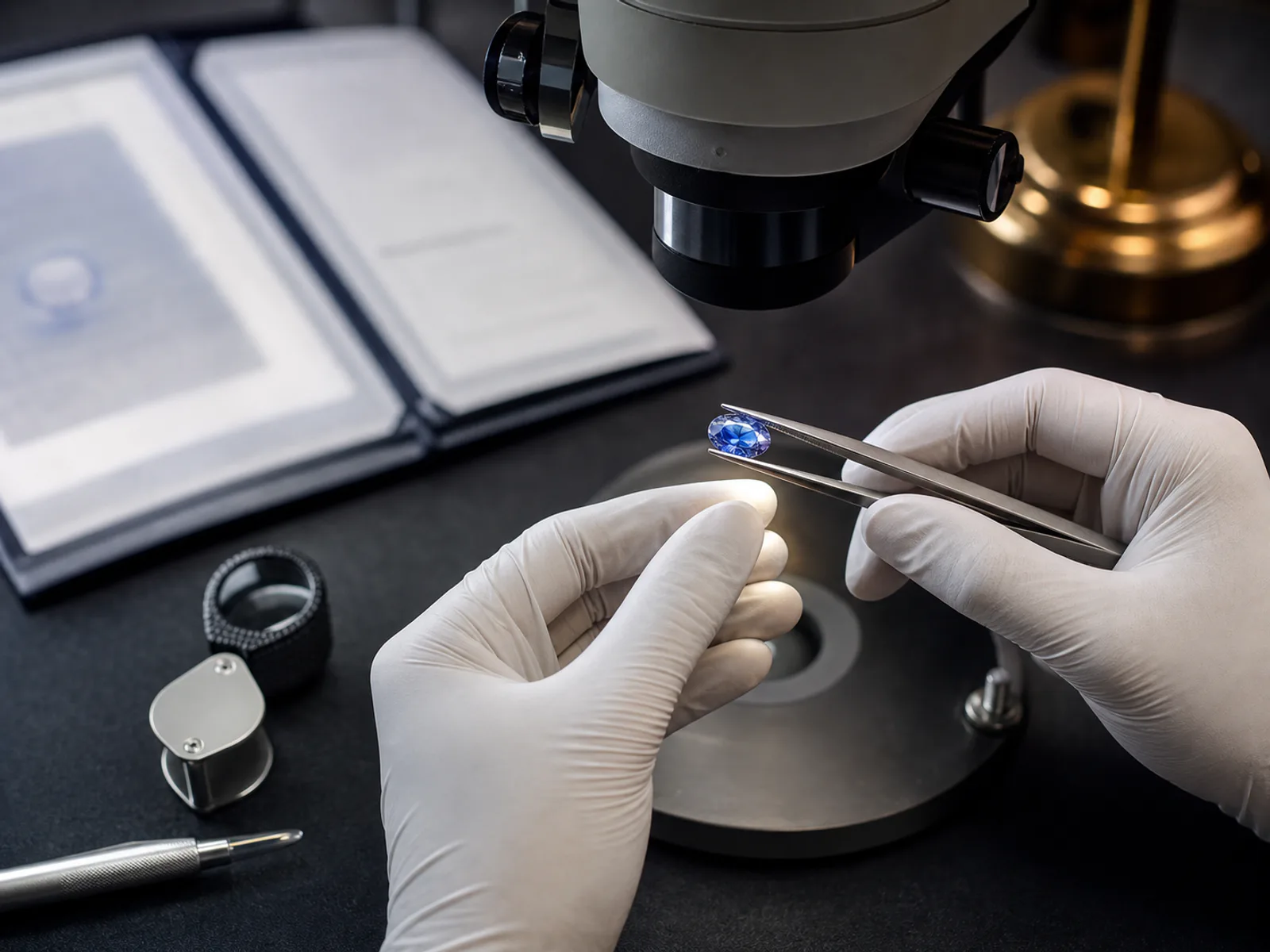
In the coloured gemstone world, the certificate is not a formality — it is half the purchase. Two sapphires can look identical across a counter and differ tenfold in value, and the only document that tells you which is which is the laboratory report.
Here is what a gem certificate actually proves, which laboratories matter, and how to read one like a dealer.
What a gem report is — and is not
A gemmological report is an identification document. It confirms what the stone is (its species and variety), and — critically for value — where it came from and whether it has been treated. It is a statement of fact from a laboratory that has no financial interest in the sale.
For coloured stones it is usually not a 'grade'. Unlike diamonds, coloured gems have no universal 4Cs scoring system; beauty is described, not scored. And a report is never a valuation — it tells you what the stone is, not what it is worth.
The laboratories that matter
Not all certificates carry equal weight. The names the international trade trusts include GIA (Gemological Institute of America), SSEF and Gübelin in Switzerland, GRS (GemResearch Swisslab) and AGL in New York. For stones from Sri Lanka, respected local laboratories such as the GIC and Ceylon's established testing labs provide reliable identification, with the Swiss and American houses used for significant stones.
A certificate from a laboratory you cannot find online, or from the seller's own 'in-house lab', is decoration, not documentation.
Reading the report line by line
Every report states the basics first:
- Species and variety — e.g. 'natural corundum, variety: blue sapphire'
- Weight in carats and exact measurements in millimetres
- Shape and cut style — oval, cushion, mixed cut and so on
- Colour description — the laboratory's objective assessment
- A report number and date — always verify it on the laboratory's own website
The two lines that decide value
Dealers turn to two entries before anything else. The first is treatment: words to the effect of 'no indications of heating' transform a stone's rarity and price; 'indications of heating' place it in the honest but far more common heated category. Stronger language — diffusion, filling, clarity enhancement — should end most conversations.
The second is origin. 'Sri Lanka (Ceylon)' is not romance, it is a gemmological opinion based on the stone's inclusion fingerprint, and it carries a genuine market premium. Not every laboratory offers origin opinions, and for Ceylon stones the origin line is worth having.
Certificate versus appraisal
Do not confuse the two documents. A laboratory report states identity and treatment. An appraisal states a monetary value, usually for insurance, and is only as good as the valuer. A seller waving an 'appraisal' with an inflated figure but no laboratory report is telling you nothing about what the stone actually is.
Red flags
Walk away, or demand better documentation, when you see:
- Certificates from unverifiable or unknown laboratories
- Report details that don't match the stone's weight and measurements
- 'Certificate available on request' for an expensive stone
- Treatment language buried in fine print — heating, diffusion or filling should be stated plainly
- Reports too old to verify online, or numbers that fail the laboratory's own check
Every stone at SPR Gems is sold with an independent laboratory certificate as standard — origin and treatment disclosed, verifiable by report number. We consider it the minimum an honest seller can offer.
See the stones for yourself
Natural, untreated, independently certified — every stone in our collection is one of one.